Showing posts with label culture. Show all posts

The world is a canvas: introducing the street art project

Donal Trung 8:00 AM Add Comment
Here today, gone tomorrow. The transient nature of street art means it can be at risk of being scrubbed out and lost forever to its legions of fans. But long after the paint has faded from the walls, technology can help preserve street art, so people can discover it wherever and whenever they like. In a new project launching today, we’ve partnered with street art experts to bring you 5,000+ images and around 100 exhibitions in the Google Art Project—telling a story of street art around the world.

Starting today, you can immerse yourself in a world of prowling foxes on lonely walls, supernatural symbolism, murals on a grand scale, tiny hard-to-spot icons, or trompe l’oeil techniques that use physical details of the wall itself to trick the eye.

Some of this work was created as a means of expression and activism, like the Chilean open-sky museums of La Pincoya and San Miguel, which were born as community projects to transform poverty-stricken neighborhoods, or to make a political statement like in London and Atlanta.

It’s not just about spraypaint either—other exhibits demonstrate the signature style of the artist, like JR’s large-scale and evocative photo-portraits, Roa’s animals, Vhils’ etching or Os Gemeos surrealism.
Regg and Violant, Centro Comercial Alegro, Setúbal, Galeria de Arte Urbana


Vhils using the texture of the wall as a canvas

Using Street View, you can also explore buildings with street art that are closed to the public, or that have already been demolished—such as the famed Paris 13 tower:


Explore all nine floors and 450 square meters of painted ceilings and walls of the now-demolished Tour Paris 13 building with Street View.

In a series of fascinating exhibitions by our partners, you can also learn about origins of the street art movement or see how Street Art is being used in Poland to revitalize its cities. Take a tour through the origins of New York’s original graffiti movement of the 90’s, or see top highlights from the city’s 5 Pointz project. Compare the global nature of the Street Art produced in Mexico, which has a long and vibrant history of muralism, to the scene in the Philippines, which is just developing.

Street art may be temporary on our walls and sidewalks, but its beauty and vibrancy live on, on the web. Take a look— you’re sure to be bowled over by the variety of the urban canvas.

Feast your eyes on new works added today to the Cultural Institute

Donal Trung 2:45 AM Add Comment
At the Cultural Institute we’ve been taking a break from our holiday shopping to feast our eyes on a different kind of gift—the gift of ingenious art that plays tricks on our eyes.

Called Trompe l'oeil, which means “fool the eye” in French, these techniques require complete control over every detail of size, color, light and gradation of color so that a two-dimensional work appears to be three-dimensional. You can see several examples amongst the new content being launched by 34 global partners today on the Cultural Institute and across our entire collection of more than 57,000 artworks.
Enter the wonderful world of Adriana Varejão—or not, it’s hard to tell. Varejão’s O Colecionador (Inhotim, Brazil)

Trompe l'oeil has been used on things as large as a ceiling—like this fresco at the National Archaeological Museum of Ferrara which uses clever architectural form to momentarily confuse:
Don’t drop that lute! Treasure Room Fresco, 1503-1506 (National Archaeological Museum of Ferrara, Italy)

And as small as a vase:
Manufacture royale de Sèvres: Vase "ferré" en première grandeur, Vers 1765-1770 (Ephrussi de Rothschild Villa & Gardens, Italy)

Sometimes the trickery lies in the deft organization of the elements in the picture, like this one. Can you find the secret image lurking within this seemingly innocent painting of a young man and woman?
Bernardino Montañés Pérez: Caprice, 1891 (Museo de Huesca, Spain)

Other new works exhibit a similar visual trickery. This relic from the Qing dynasty comes from the National Palace Museum of Taiwan—does the cabbage look good enough to eat?
Unknown: Jadeite Cabbage, Qing Dynasty (National Palace Museum, Taiwan)

Or take a look at the Musée d’Orsay’s exhibition of its unusual history, and then compare the details of the former station to the indoor Street View imagery of today's modern museum:
The station d'Orsay in its heyday. (Musée d’Orsay)
The Musée d’Orsay on Street View

From Trompe l'oeil to archaeological artifacts, royal portraits and famous scientists, there’s a lot to discover in the latest collection, which comes from all over the world. Enjoyed the visual trickery? See what else can you spot and tell us your favorite examples on our Google+ page.

Learn about the atomic bombings of Hiroshima and Nagasaki on the Google Cultural Institute

Donal Trung 8:08 AM Add Comment
This August marks the 68th anniversary of the atomic bombings of Hiroshima and Nagasaki at the end of World War II. Working together with the Hiroshima Peace Memorial Museum and the Nagasaki Atomic Bomb Museum, we’ve launched seven new online exhibits on the Google Cultural Institute that help tell the story of the two cities and their tragic fate.

Explore four collections from the Hiroshima Peace Memorial Museum that illustrate the bombing from different perspectives: a pocketwatch stopped at the exact time of the detonation, diaries of young women cut off abruptly on August 6, and panoramic photos of the hauntingly barren city center days after. While most of the materials document the harrowing devastation of the bomb and its aftermath, the gallery “Recalling the Lost Neighborhoods” helps archive the old Hiroshima that vanished off the map.
Pocketwatch showing 8:15, the time of the atomic bomb drop (from the Hiroshima Peace Memorial Museum)

The Nagasaki Atomic Bomb Museum meanwhile curated photos, videos, and drawings in three exhibitions. One collection focuses on the famed Urakami Cathedral—the largest cathedral in East Asia where 15,000 Japanese Catholics once worshipped. The church completely collapsed after the bombing, but thanks to a post-war reconstruction effort, the Urakami Cathedral now stands triumphant as a symbol of the city’s rebirth.
Urakami Cathedral exhibition (from the Nagasaki Atomic Bomb Museum)

Speaking at an unveiling ceremony for the exhibits in Hiroshima today, Hiroshima Mayor Kazumi Matsui said, “Through the Google Cultural Institute exhibitions, we hope that people around the world would learn about the terrible experiences of the Hibakusha, or A-bomb survivors, and wish for peace.”

The Cultural Institute was created to help preserve the world's history and heritage. Given the average age of the Hibakusha is now past 78, we're honored that our digital exhibit can help keep the memories from both cities alive for the future.

From Sutton Hoo to the soccer pitch: culture with a click

Donal Trung 12:00 AM Add Comment
Museums, libraries and galleries are a tourist staple of the summer holiday season. Often they’re the first place we head to when visiting a new city or town in order to learn about the heritage of that country. Though only a lucky few have the chance to travel to see these treasures first-hand, the Internet is helping to bring access to culture even when you can’t visit in person.

At the Google Cultural Institute, we’ve been busy working with our partners to add a range of new online exhibitions to our existing collection. With more than 6 million photos, videos and documents, the diversity and range of subject matter is large—a reflection of the fact that culture means different things to different people. What the exhibitions have in common is that they tell stories; objects are one thing but it’s the people and places they link to that make them fascinating.

The British Museum is the U.K.’s most popular visitor attraction and the 4th most visited museum in the world. It’s well known for housing one of the most spectacular archaeological discoveries ever made—the 1,400 year old Anglo-Saxon burial from Sutton Hoo, untouched until its discovery in 1939. Their online exhibition “Sutton Hoo: Anglo-Saxon ship burial” explores the discovery of the ship, featuring videos of the excavation and photos of the iconic helmet and a solid gold belt buckle. All this tells the story of how the burial and its contents changed our understanding of what Anglo-Saxon society was like.


From archaeology we take you to sport, which is integral to the culture of many nations, including Brazil. In the lead-up to Brazil's hosting of the 2014 World Cup, the Museu do Futebol has told the story of how the “beautiful game” came to Brazil. The photos, videos and posters in “The Game and the People” track the social impact of the sport and its transition from a past time for the wealthy (with their pleated pants and satin belts) to the modern game.

Science remains a perennially fascinating topic and the Museo Galileo in Italy has put together a series of three exhibitions looking at the link between art and science. The Medici Collections, the Lorraine Collections and the Library Collections examine the beginnings of science and technology 500 years ago and chart developments from the discovery of the sun dial to the Google Maps of today. As well as being informative, the exhibitions include beautiful objects such as the Jovilabe, which was used to calculate the periods of Jupiter’s moons.


So if broadening your cultural horizons through travel isn’t in the cards this summer, settle down in your armchair and browse through through some of the world’s heritage and history online. Keep up to date with new material on the Cultural Institute Google+ page.

Mario Testino to "The Scream" via Mark Rothko

Donal Trung 1:00 AM Add Comment
Every day on the Art Project Google+ page we post a snippet of information about a painting, an artist or a talk—and every day, at least one of our 4 million followers has something to say in response. We’re constantly delighted by how the appetite for art online is growing and today we have a veritable feast in store with a swathe of fresh artworks, gigapixel paintings and museums on Street View.

New artworks from the famous to the unusual
Mario Testino is a world-famous photographer, known for his work in the fashion industry. Fewer people are aware of his photographs focusing on the culture of his native Peru. A new body of photographs called “Alta Moda” (high fashion), featuring Andean people in traditional and festive dress, is currently on display in Testino’s cultural institution, MATE. And for those of you not lucky enough to visit Lima, you can now see this collection of 27 photos online on the Google Art Project.


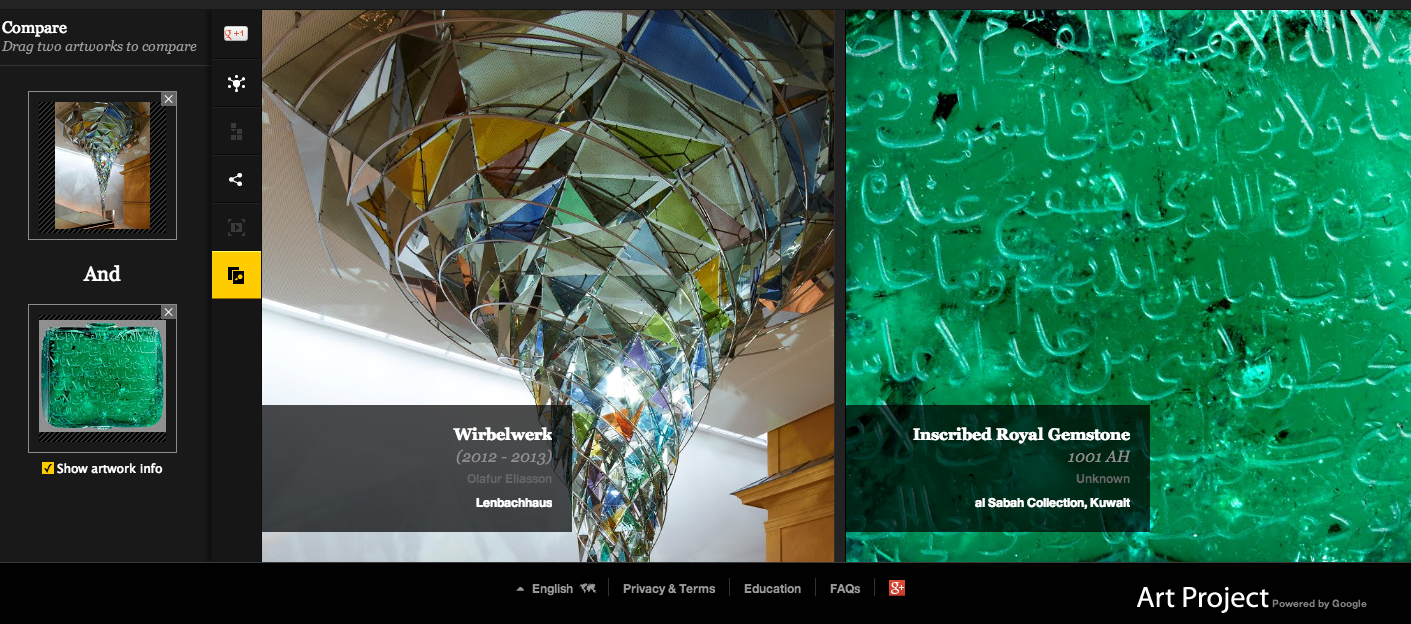
In total, we have more than 1,500 new high-resolution artworks including masterpieces such as Monet’s “Waterlilies,” Rembrandt’s “Portrait of a Man in a Broad-Brimmed Hat” and Johannes Vermeer’s “The Geographer” (meaning Art Project now houses 15 of his 34 total works, all contributed by different museums). However, the diversity goes well beyond paintings; from ancestral relics used to worship the dead to an ancient Jinsha gold mask from China thought to have been worn by sorcerers. Often the old contrasts with the new, with inscribed Arabic gemstones existing alongside contemporary glass structures from Germany as you can see in this “Compare” image below.


Zoom in to “gigapixel” paintings
Gigapixel paintings—very high-resolution works which enable you to zoom in at brushstroke level—have long been at the heart of the Art Project. They’re a great example of the magic that can happen when technology meets art—and today we have 16 new ones to add, ranging from famous pieces like “The Scream” by Edvard Munch to those chosen by public vote such as “Whitewashing the Old House” by L.A. Ring.

The beauty of gigapixels is their ability to surprise. Look at the painting “Fra Stalheim” by Johan Christian Dahl, shown in full on the left below. You’ll see a beautiful landscape. Zoom in, however, and you discover scenes within a scene—a village with smoking chimneys, a woman tending to her child, and cows grazing on the hillside. Details that can’t always be fully appreciated by the naked eye are brought to life online.


Immerse yourself in Street View
Through Street View and the Google Art Project, many museums have opened their galleries to the world the past few years, and today we’re launching 20 more. For example, Fondation Beyeler Museum in Switzerland houses a collection of seven Mark Rothko paintings. Now anyone in the world can virtually explore the collection.


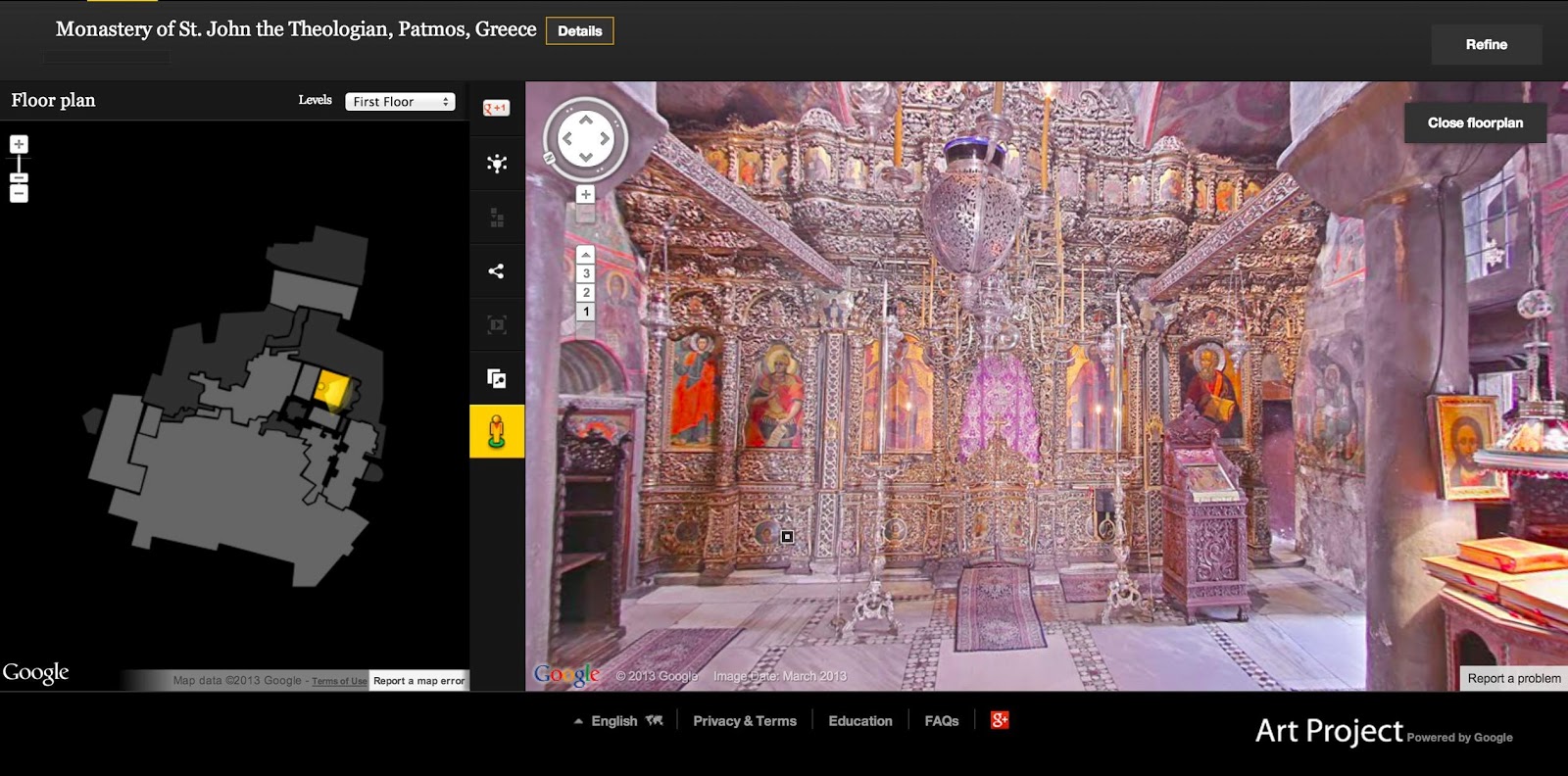
Of course art collections are not exclusively found in museums—we’re delighted to have our first monastery on Street View in the Art Project. The Monastery of St. John the Theologian on the Greek island of Patmos was founded in 1088 and is a World Heritage Site. In addition to their 116 contributed artworks, you can also explore the architectural splendors of this ancient building.


Jump inside a whole range of beautiful buildings and corridors here by clicking on the orange pegman where it appears.

In a week that celebrates International Museum Day, we’re glad to be able to showcase some of the great treasures held by museums and cultural institutions the world over. There are so many benefits to bringing more content online, be it discovering a new style of art or artist, creating your own gallery, stumbling across a hidden detail of a painting you thought you knew or simply being inspired by something beautiful. With more than 40,000 total works and 250+ cultural organisations around the globe, we hope the experience will be more enriching than ever.

Urban art, zoomorphic whistles and Hungarian poetry

Donal Trung 1:01 AM Add Comment
There are few places (if any) in the world where you could find urban art, zoomorphic whistles* and Hungarian poetry in a single place—except, of course, on the Internet.

Today 30 new partners are joining the Google Art Project, contributing nearly 2,000 diverse works including contemporary art from Latin America, ancient art from China, rare Japanese paintings and Palaeolithic flint heads from Spain.

One highlight of the new collection is a project to capture the growing trend of urban art and graffiti in Brazil. More than 100 works from walls, doors and galleries in São Paulo have been photographed and will be included in the Art Project. The pieces were chosen by a group of journalists, artists and graffiti experts and include artists such as Speto, Kobra and Space Invader, as well as images of São Paulo’s most famous building-size murals. You can see the contrast in styles in the Compare tool and image below.


Photography features strongly in the works our partners are bringing online this time around. The Fundacion MAPFRE in Spain showcases one of the largest collections with more than 300 photos from a number of renowned photographers. For example, you can explore Mexican photographer Graciela Iturbide’s black and white images of indigenous Mexican culture inspired by themes of ritual, death and feminism.

The Art Project is also becoming a home to rare and precious items which move beyond paintings. Petőfi Literary Museum in Hungary has contributed the Nemzeti Dal or “National Song,” a Hungarian poem which is said to have been the inspiration for the Hungarian Revolution of 1848. The original document has rarely been seen in public to prevent humidity and light fading the script further. Online now for the first time, it can be explored by anyone in the world.

With 40,000+ artworks to explore from more than 200 museums in more than 40 countries, we look forward to seeing these new works feature in hundreds of thousands of user galleries you have created to date. Keep an eye on our Google+ page for more details about the new collections.

*ceramic whistles in the shape of animals!